
What Are Wood Veneer Panels?
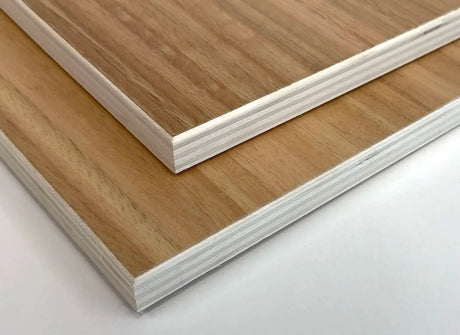
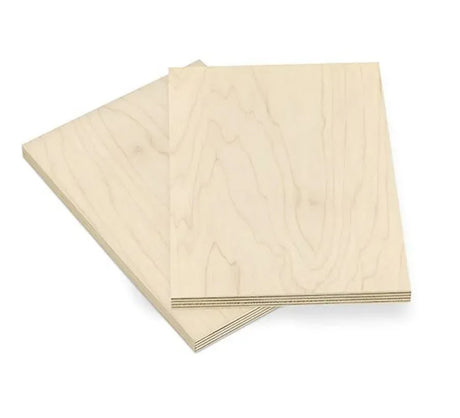
Wood veneer panels are made by bonding a thin layer of precious A-grade premium timber veneers (rotary-cut, crown-cut or quarter-cut) 0.3-5 mm thick, to plywood, MDF, OSB, FOSB or particle board. Natural wood veneer provides a timber look, while the substrate determines the panel’s thickness, stability, weight, machining quality and physical performance.
Most Australian and overseas hardwoods, such as Tasmanian Oak, Spotted Gum, Blackwood, Blackbutt, Walnut, Oak and Maple, grow for 50 to 200 years to reach commercial maturity before harvesting and peeling into high-quality veneer. The combination of the thin, long-growing hardwood veneers and thick, cost-effective substrates manufactured from fast-growing woods helps preserve long-growing, precious wood species for future generations without compromising aesthetics.
Wood veneer panels may vary in colour, grain, and texture, unlike HPL or Melamine-laminated panels, where every panel looks the same. The appearance of wood veneer panels depends on the colour of the raw material, wood species, veneer cutting type (rotary, crown, or quarter-cut), and matching method (book-matched, slip-matched or mismatched). Together, these factors create natural beauty.
Types of wood veneer panel substrates suit different applications. Veneered plywood is used where bending strength, screw-holding, impact resistance or exposed edges are important. Veneered panels on MDF, OSB and FOSB are used for joinery, cabinetry, furniture and wall panels and are usually selected for decorative or architectural interior applications where mechanical performance is not a priority.
Ply Online stock of natural wood veneer panels is intended for interior use. Check the product description and data sheets in our Knowledge Base for substrate, thickness, sheet size, finish, moisture resistance, fire rating, emissions class and recommended applications, or simply call our friendly team for technical advice before ordering.
Choose by Substrate
-
![Textured patterned wood veneered plywood sheet close-up]()
Plywood
Veneered plywood is a good choice when the panel needs both a real timber surface and better strength than MDF. It is commonly used for cabinetry, furniture, shelving, wall panels, shopfitting and commercial joinery.
Choose veneered plywood where screw-holding, panel strength, lower weight or exposed plywood edges matter. The visible veneer gives the timber appearance, while the plywood core affects stability, machining and fixing performance.
-
![Close-up of a wooden veneered MDF surface with a clear coated brown finish]()
MDF
Veneered MDF is best for flat interior panels where a real timber surface is needed without the layered edge of plywood. It is commonly used for cabinet doors, wall panels, furniture, reception counters and shopfitting.
It is usually easier to machine cleanly than plywood and works well for decorative joinery where the edges will be lipped, edged, painted or otherwise finished.
Veneered MDF is for interior use and should not be used outside or in wet areas unless the specific product is rated for that application.
-
![Close-up of a wood veneered FOSB sheet surface with visible grain and texture]()
FOSB
Veneered FOSB (Fine surface Oriented Strand Board) is used where the panel needs a real timber surface with a more architectural or design-led board structure. It is suitable for interior feature walls, display retail fit-outs, furniture details, exhibition stands and creative commercial interiors.
It is usually more project-specific than veneered plywood or MDF, so it should be selected carefully for the intended application, fixing method and finish.
Veneered OSB / FOSB should be treated as an interior panel.


Where Wood Veneer Panels Are Used
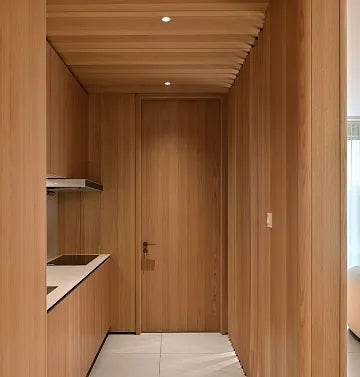
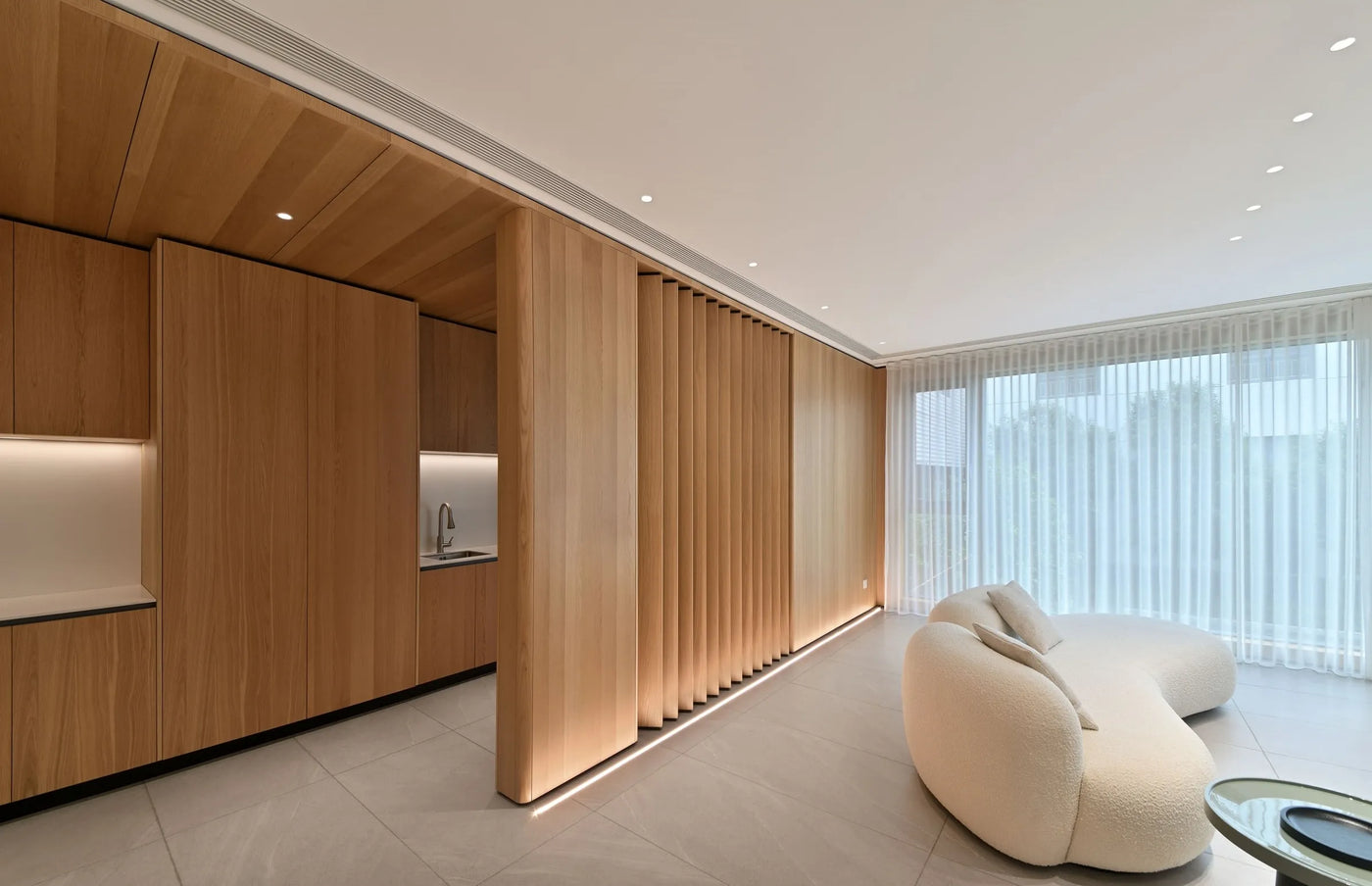
Wood veneer panels are used across the Australian residential, commercial and architectural market where a real timber surface is required in a practical sheet format. They are commonly specified for interior wall linings, ceiling panels, cabinetry, furniture, wardrobes, reception counters, shopfitting, office fit-outs, hospitality interiors and retail displays.
Interior wall panels, ceiling panels, cabinetry and furniture may all require different substrates, fixing methods, fire-rating requirements, finishes and maintenance considerations. For commercial projects in Australia, technical data sheets should be checked before specification, especially where fire performance, emissions class, durability or installation conditions are relevant.
Wood Veneer Panels vs Laminated Panels vs Solid Timber
Understanding the differences between these materials helps you select the right product for your project based on appearance, durability, cost, stability and application requirements.
Wood Veneer Panels
Real timber veneer surface-bonded to a substrate such as plywood, MDF, OSB, FOSB, or particleboard. Used for interior walls, ceilings, cabinetry, furniture, and joinery. Provides authentic timber appearance with dimensional stability and availability in large sheet format. Not resistant to heat, direct sunlight and extremely humid or dry climates.
Laminated Panels
Man-made decorative surface, printed on the melamine paper or high-pressure laminate, 0.3-0.7 mm thick. Laminated Panels are washable, more scratch-resistant, moisture-resistant, abrasion- and heat-resistant and easy to clean. Timber pattern on the laminated panels will look the same on every sheet of material. Suitable for wear-resistant horizontal and vertical surfaces and commercial fit-outs.
Solid Timber
Solid timber panels are made from a single natural piece of milled wood and require moisture stabilisation and surface treatment to prevent warping and cracking. It is a naturally beautiful material, suitable for flooring, decking, furniture, battens, trims, and high-end detailing. As a result, solid wood is more expensive, often heavier, and prone to contraction, expansion, warping, and cracking (especially woods with curly grain like Spotted Gum), and is less practical in large sheet formats. It is not resistant to heat, direct sunlight, or climate extremes.
| Material | What it is | Best used for | Main limitation |
|---|---|---|---|
| Wood veneer panels | Real timber veneer (0.5–5mm) bonded to plywood, MDF or OSB substrate | Interior walls, ceilings, cabinetry, joinery, furniture. Large sheet format (2400 × 1200mm typical) | Interior use only. Not suitable for wet areas, flooring or structural applications unless product data confirms otherwise |
| Laminated panels | Printed or pressed decorative surface layer over substrate | High-wear surfaces, benchtops, commercial fitouts, easy-clean applications | Not real timber. Limited repair options if damaged. Can show wear at edges |
| Solid timber | Timber through full thickness (typically 19–42mm boards) | Furniture, battens, trims, feature detailing, structural framing | Prone to movement and warping. Heavy. Not available in large sheet sizes |
Important: Wood veneer panels are generally interior products and should not be assumed suitable for exterior cladding, wet areas, flooring or structural applications unless the individual product data sheet confirms that use. Always check manufacturer specifications and Australian Standards compliance for your intended application.

Wood Veneer Face Grades Explained
In the woodworking industry, veneer grades are classified by quality under Australian or European Standards. Standards outline the number of visible defects allowed per square meter of the veneer surface. Veneer grades identified by letters:
- A - highest quality, virtually free of visible imperfections like pin knots and minimal discolouration.
- B - premium quality, with minimal visible defects and discolouration.
- BB - good quality, featuring discolouration, mineral staining and repair inserts. Suitable for veneering, painting, lamination, or use on concealed surfaces.
- C – repairs, open knots, joints and other visible defects are allowed. Suitable for structural applications where appearance is not a priority.
When a panel is veneered on both face surfaces, the letter designations separated by /, for example, A/B, indicate that the front surface is overlaid with grade A veneer, and the back surface is veneered with grade B veneer.
Available Thicknesses and Sheet Sizes
Wood veneer panels are available in different wood veneers, finishes, substrates, sheet sizes and thicknesses, depending on the product. Always check thickness, wood veneer specie, finish, sheet size, edge profile and availability in the product listing before ordering. Stock quantities may vary depending on the wood species, sizes and manufacturer.
MR MDF, MR FOSB, Birch Plywood and Poplar Plywood cores are generally selected where a moisture-resistant interior substrate is required, subject to the product’s technical data sheet. Wood veneer panels are intended for interior application unless manufacturer confirms otherwise.
The four-side edged and grooved plywood substrate is designed for panel-style and shadow line installation where the edge profile and modular width are part of the fixing or visual system. It is suitable for interior wall lining, ceiling or decorative lining applications, depending on the veneer species, finish, installation method and project requirements.
For commercial or specified projects, confirm the wood veneer specie, substrate type, total area coverage, waste allowance, edge profile, and installation direction before ordering.
| Core | Available Sizes | Thickness | Sheet Area |
|---|---|---|---|
| MR FOSB | 2745 × 1220 mm | 19 mm | 3.3489 m² |
| MR MDF | 3050 × 1220 mm | 19 mm | 3.721 m² |
| Plywood | Birch: 2780 × 300 mm / 2780 × 600 mm / 2780 × 900 mm Poplar: 2500 × 1220mm |
15 mm 12 mm, 15 mm, 18 mm |
0.834 m² / 1.668 m² / 2.502 m² 3.05 m² |
FAQs
Are wood veneer panels real timber?
Are wood veneer panels real timber?
Yes. The surface layer is real timber veneer. The core is an engineered board substrate.
Are your wood veneered panels structurally rated?
Are your wood veneered panels structurally rated?
Most wood veneer panels are decorative interior panels, not structural panels. They should not be used for bracing, flooring, load-bearing work or structural applications unless the product data sheet specifically confirms the required structural rating.
What is the difference between wood veneer and laminate?
What is the difference between wood veneer and laminate?
Wood veneer is real timber. Laminate is made of multiple layers of compressed paper and wood materials bonded together with plastic resins under high heat and pressure. Laminate imitates timber pattern, but it is not real timber veneer.
Do wood veneer boards need edge banding?
Do wood veneer boards need edge banding?
Yes, in most finished joinery and furniture applications, wood veneer panels need edge banding, lipping or another edge treatment. The veneer is normally applied to the face of the board, while the core material remains visible on the edge after cutting.
For veneered MDF, edge banding is usually required because the MDF core is not intended to be left exposed. For veneered plywood, the edge may sometimes be used as a design feature, but it still needs to be sanded, sealed and finished properly. For veneered OSB or FOSB, the edge treatment depends on the design intent, but exposed edges should still be protected.
Edge banding improves appearance, protects the core, reduces moisture absorption through the edge and gives the panel a cleaner finish. The correct edging method depends on the substrate, veneer species, finish and application.
Can wood veneer panels be sanded?
Can wood veneer panels be sanded?
No. Finished wood veneer panels should not be sanded as a normal preparation or adjustment method. The veneer surface is already factory-finished, and sanding can damage the coating, create visible dull patches, cut through the veneer layer or expose the substrate underneath.
If minor edge work is required after cutting, it should be handled carefully and kept to the edge or cut line only. Do not sand the finished face unless the manufacturer specifically confirms that the product can be sanded and refinished.
For best results, treat finished wood veneer panels as a prefinished decorative surface. Use sharp tooling, protect the face during handling and installation, and test cutting or machining on an offcut before full production.
Can timber veneered panels be CNC machined?
Can timber veneered panels be CNC machined?
Wood Veneer Panels can be CNC machined; the quality of the CNC machining depends on the substrate, veneer thickness, finish and cutting tools. Testing is recommended for detailed work.
Where can I find eco-friendly wood veneer panel suppliers in Australia?
Where can I find eco-friendly wood veneer panel suppliers in Australia?
Look for suppliers offering FSC®-certified wood veneer products sourced from responsibly managed forests. Eco-friendly panels should also provide information about species origin, formaldehyde emissions and environmental certifications. At Ply Online, we offer a range of FSC-certified products suitable for shopfitting, cabinetry, and architectural projects, with Australia-wide delivery.
What is veneer matching?
What is veneer matching?
Veneer matching refers to how veneer leaves are arranged on the panel face. Common methods include book matching, slip matching and random matching. The matching method affects the visual consistency, grain pattern and appearance across large panels or multiple sheets.
Native Grain Collection
View allWholesale Prices
Buying Bulk? Ask for free samples and the best price for delivery to your doorstep.
-

Ply Online
From $18.5Unit price$0.0 /UnavailableIn stock (211 units) -
 Sale
SalePly Online
Okoume Plywood B/BB 4mm, 3 plies, for laser cutting
From $14.0$19.0Unit price$0.0 /UnavailableIn stock (136 units) -
 Sale
SalePly Online
Tasmanian Oak (Blue Gum) Lightweight Plywood A/C UV Coated
From $189.0$236.0Unit price$61.97 / m2UnavailableIn stock (437 units) -
 Sale
SalePly Online
Premium Maple Reinforced Plywood AB/B Hybrid Core
$186.0$257.0Unit price$62.42 / m2UnavailableIn stock (60 units) -

Ply Online
American Walnut Veneer T&G Wall Panel UV-Coated A/BB
From $121.0Unit price$36.13 / m2UnavailableIn stock (292 units) -
Sale
Ply Online
Spotted Gum Timber Veneer Panel A/B UV-Coated FOSB 19x2745x1220 mm
$366.0$379.0Unit price$109.29 / m2UnavailableIn stock (224 units) -
Ply Online
Tasmanian Oak Timber Veneer Panel A/B UV-Coated MDF 19x3050x1220 mm
$360.0Unit price$107.5 / m2UnavailableIn stock (219 units) -
Ply Online
Spotted Gum Timber Veneer Panel A/B UV-Coated MDF 19x3050x1220 mm
$548.0Unit price$163.64 / m2UnavailableIn stock (222 units)